 Arctic Council Working Group
 2027 Polar Maritime Seminar
The 2027 Polar Maritime Seminar is co-sponsored by IMO and the Kingdom of Denmark's Chairship of the Arctic Council, in cooperation with PAME.
Location: IMO Headquarters
Date: 1 and 2 February 2027
Master of Ceremonies: TBC
The conveners gratefully acknowledge funding from the Nordic Institute in Greenland and the US Government.
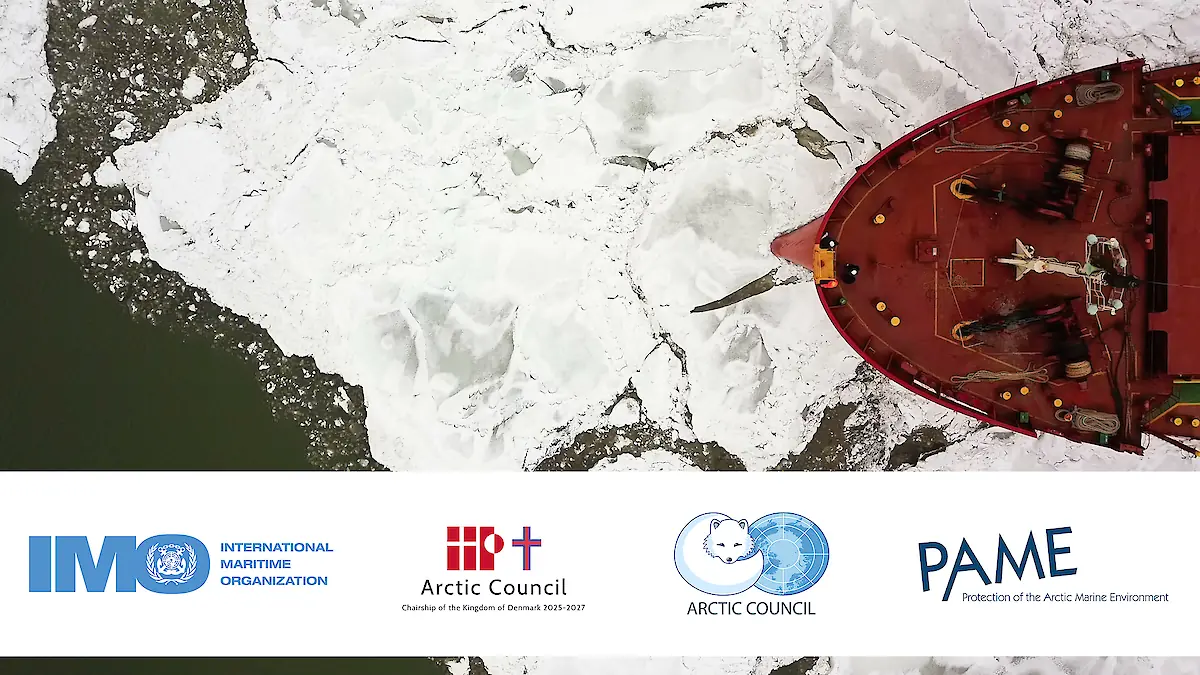
The purpose of the Seminar is to provide an update on polar shipping developments, including current challenges of polar navigation; recent international legal and policy developments; global market and trade developments; socio-economic, cultural and environmental considerations for Indigenous Peoples and local communities; the perspective of Arctic ports and harbours; lessons learned from recent groundings; the experience of research ship operators; and fishing vessel safety in polar waters and related environmental considerations.
The provisional programme covers 8 sessions, each comprising presentations followed by question-and-answer discussion open to all participants.
The agenda is available to the right, with more speakers added as they are confirmed. The full agenda will be available in November.
- Who can participate
- Participation is open to all PAME Members, all IMO Member States and Associate Members, United Nations and specialized agencies, intergovernmental organizations and non-governmental organizations in IMO consultative status, and by invitation, to the representatives of academic institutions and other organizations with an interest in polar shipping.
- Language
- The Seminar is in English only, without interpretation.
Registration has started. Please register below.
Go to registrationDraft agenda · 1–2 February 2027
Discussion Panels
Subject to change ahead of the final program. Click a panel title or Details to see the moderator, description and speakers.
Current Challenges of Polar Navigation
Moderator: Mr. Hjalti Hreinsson, Deputy Secretary, PAME International Secretariat
Polar navigation presents significant challenges, including unpredictable sea ice movements, icebergs, extreme weather such as storms and polar lows, and sea-spray icing that can compromise ship stability. Other key considerations include the availability and adequacy of port infrastructure and search and rescue capabilities. Safe operations also depend on access to up-to-date nautical charts and on reliable, resilient communications at high latitudes. This panel will discuss selected aspects of these topics.
- Ms. Manon LarocqueChair, Arctic Regional Hydrographic Commission (ARHC); Hydrographer General of Canada and Director General, Canadian Hydrographic Service (CHS), Fisheries and Oceans Canada
- Ms. Marianne ThyrringDirector General, Danish Meteorological Institute (DMI), Kingdom of Denmark, Member of International Ice Charting Working Group (IICWG);
- Mr. Tore HongsetSAR Mission Coordinator, Joint Rescue Coordination Centre North Norway (JRCC NN); Chair, SAR Expert Group, EPPR
- Fednav representativeSpeaker to be identified
Recent International Legal and Policy Developments Affecting Polar Shipping
Moderator: Ms. Charlotte Mogensen, Chair, Arctic Shipping Best Practice Information Forum, Kingdom of Denmark
This panel will identify recent legal and policy developments affecting shipping in both polar regions, including decisions and measures adopted at the IMO (such as work on black carbon emissions from ships), developments within the Antarctic Treaty System, and evolving interpretations of the law of the sea in Arctic waters.
- Mr. Fausto Lopez CrozetNational Director of Antarctic Foreign Policy, Ministry of Foreign Affairs, International Trade and Worship, Argentina
- Dr. Sascha PristromHead, Marine Technology and Goal-Based Standards, Maritime Safety Division, International Maritime Organization (IMO)
- Dr. Suzanne LalondeProfessor of International Law, Faculty of Law, Université de Montréal, Canada
- Mr. Kristoffer KjærsgaardHead of Section, Ministry of Environment and Gender Equality, Kingdom of Denmark
- Dr. Sian PriorLead Adviser, Clean Arctic Alliance
Global Market and Trade Developments Influencing Polar Shipping
Moderator: Ms. Soffía Guðmundsdóttir, Executive Secretary, PAME International Secretariat
This panel will discuss the market and trade dynamics shaping current and future Arctic shipping. Factors such as fuel prices, freight rates, operating and insurance costs, changing patterns of global demand, and the search for efficient and resilient supply chains all influence the commercial case for Arctic routes, alongside the region's economic potential. The panel will bring together the perspectives of analysts, researchers and shipping companies.
- Dr. Mia BennettAssociate Professor, Department of Geography, University of Washington
- Dr. Heather Exner-PirotSenior Fellow and Director, Natural Resources, Energy and Environment, Macdonald-Laurier Institute, Canada
- Shipping company perspectiveSpeaker to be confirmed
- Shipping company perspectiveSpeaker to be confirmed
The Increase in Arctic Shipping: Socio-economic, Cultural, and Environmental Considerations for Indigenous Peoples and Local Communities
Moderator: Mr. Drummond Fraser, Transport Canada; PAME Shipping Expert Group Co-Chair
This panel will discuss how increasing Arctic shipping over the last 15 years has benefited and/or burdened Indigenous and local communities, and how these communities aim to take advantage of those benefits and reduce and mitigate the burdens.
- Inuit Circumpolar Council (ICC) GreenlandSpeaker to be identified
- Mr. Jim GambleSenior Director, Arctic Program, Pacific Environment, Anchorage, Alaska
- Dr. Elena KavanaghResearcher and Lead, Indigenous Rights Cluster, Centre for Criminal Justice and Human Rights (CCJHR), School of Law, University College Cork, Ireland
- Dr. P. Whitney LackenbauerCanada Research Chair (Tier 1) in the Study of the Canadian North and Professor, School for the Study of Canada, Trent University, Canada
Changes in Arctic Shipping: A View from Arctic Ports and Harbors
Moderator: Mr. Peter Oppenheimer, Chief, International Section, NOAA, USA; PAME Shipping Expert Group Co-Chair
This panel will discuss how Arctic ports and harbors, and ports serving Arctic trade, view the increase in ship traffic and its changing composition, the steps they are taking or planning in response, and what further changes they consider necessary.
- Mr. Mike McNairPresident and CEO, Arctic Economic Development Corporation (AEDC), Canada
- Mr. Niels ClemensenChief Executive Officer, Royal Arctic Line A/S, Greenland
- Dr. Umji KimDirector, Polar Strategy Research Division, Korea Maritime Institute (KMI), Republic of Korea
Lessons Learned from Recent Groundings in the Polar Regions
Moderator: Mr. Drummond Fraser, Transport Canada; PAME Shipping Expert Group Co-Chair
This panel will examine recent groundings in polar waters and the lessons they offer for safety, search and rescue, incident reporting and navigation in poorly charted areas. Cases include the fishing vessel Arctic Sea, which grounded on St. George Island in the Bering Sea on 5 January 2026, with all nine crew rescued by the U.S. Coast Guard; the Dutch general cargo ship Thamesborg, which struck an uncharted shoal in Franklin Strait in the Northwest Passage in September 2025 and was refloated after a six-week salvage operation; and the Canadian cargo ship Rosaire A. Desgagnés, which grounded in Pelly Bay, Nunavut, in August 2025 during a community resupply voyage. The panel will also consider the Antarctic perspective and the role of incident reporting to the IMO.
- Ms. Leedwine David PichonImplementation Support Officer, Department for Member State Audit and Implementation Support, International Maritime Organization (IMO)
- Ms. Caroline JupeChief Executive Officer, International Maritime Rescue Federation (IMRF)
- Capt. Jonathan WelchUnited States Coast Guard
Experience of Research Ship Operators in the Arctic and Antarctic
Moderator: Mr. Peter Oppenheimer, Chief, International Section, NOAA, USA; PAME Shipping Expert Group Co-Chair
While much attention is given to increasing commercial ship traffic, research vessels continue to operate in both polar regions for longer periods and for a widening range of purposes. This panel will share the experiences of research ship operators in the Arctic and Antarctic, including lessons being built into the next generation of research icebreakers, such as low underwater noise and emissions, and how these can inform sustainable navigational safety.
- Ms. Anu PeippoOffshore Segment Director, Steerprop
- Ms. Pilvi SaarikoskiPolar Scientific Innovation Lead, British Antarctic Survey (BAS), United Kingdom
- Alfred Wegener Institute representativeSpeaker to be identified
Fishing Vessel Safety and Related Environmental Considerations in the Polar Regions
Moderator: Mr. Michael Kingston, PAME Special Advisor
Fishing vessels play a major role in both polar regions. This panel will cover international safety frameworks and legal obligations, including implementation of the Cape Town Agreement, as well as environmental issues such as lost and abandoned fishing gear, gear management plans and port reception facilities.
- Ms. Åsa TeirinFaroese Maritime Authority
- Mr. Wouter-Jan StrietmanResearcher and Project Manager, Wageningen Social & Economic Research, Wageningen University & Research, Netherlands
- Mr. Robert GreenwoodFishPlatform
- Ms. Paula Saiz CalvoMaritime Captain (Capitana Marítima) of Algeciras, Directorate General of the Merchant Marine, Ministry of Transport and Sustainable Mobility, Spain