 Arctic Council Working Group

The Central Arctic Ocean - Ecosystem status, human impact and management measures
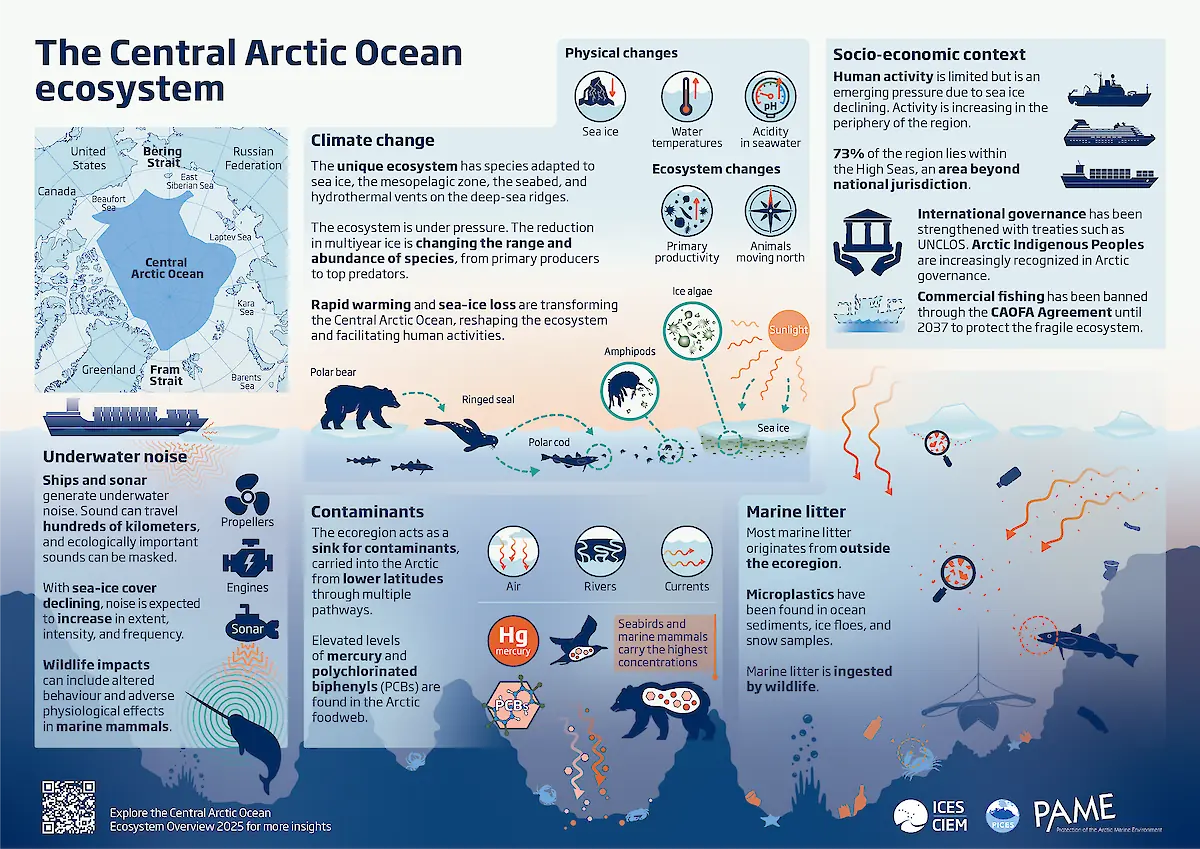
The Central Arctic Ocean is changing faster than almost anywhere on Earth. PAME's Central Arctic Ocean Synthesis Report (CAO-SR, 2025) brings together what we know about the ecosystem, human activities and pressures, and the management measures in place, to inform future policy for the high Arctic Ocean.

The Central Arctic Ocean: Ecosystem status, human impact and management measures
PAME / Arctic Council, 2025.
Download the report (PDF)- 2013Central Arctic Ocean Large Marine Ecosystem adopted by Arctic Council Ministers
- 2021Agreement to Prevent Unregulated High Seas Fisheries in the CAO enters into force
- 2025PAME publishes the Central Arctic Ocean Synthesis Report
- 2026BBNJ "High Seas Treaty" enters into force, enabling marine protected areas beyond national jurisdiction
A disappearing ice cover in the Central Arctic Ocean
The Central Arctic Ocean (CAO) has historically been covered by multi-year sea ice and largely inaccessible. Due to climate change, summer sea ice is rapidly disappearing. Some recent modelling studies indicate that the Arctic Ocean could be virtually free of sea ice in September before 2050, irrespective of emission scenario.
The shift from stable multi-year ice to a seasonally ice-free ocean will likely have impacts at local, national, regional and global levels. There is already evidence that some Arctic species are moving northward and that parts of the food web are changing. These changes, together with growing human pressures such as Arctic shipping and fishing, will affect the status of the ecosystem and its need for protection. With change this rapid, it is timely to gather existing knowledge on the Central Arctic Ocean to inform effective policy and decision making.
History and purpose of the report
Arctic Council work has repeatedly stressed the importance of understanding current and future conditions in the Central Arctic Ocean, including to inform the Agreement to Prevent Unregulated High Seas Fisheries in the Central Arctic Ocean, which entered into force in 2021.
The 2021 Arctic Council Strategic Plan set the goal of synthesizing relevant information on the status, trends and projected changes in the Central Arctic Ocean, human activities and pressures in the area, and the current management measures in place, in order to inform future policy and decision making. Led by PAME, the CAO-SR responds directly to that goal.
The report is situated within Arctic Council initiatives and other international processes. PAME's Framework for a Pan-Arctic Network of Marine Protected Areas sets out the vision for an ecologically connected, representative and effectively managed network of protected and specially managed areas in the Arctic. The BBNJ Agreement (Agreement under the UN Convention on the Law of the Sea on the conservation and sustainable use of marine biological diversity of areas beyond national jurisdiction), adopted in 2023 and in force since 17 January 2026, provides a mechanism for establishing area-based management tools, including marine protected areas, on the high seas. How the Central Arctic Ocean may be included in this work is not yet known.
Report objectives
- Understand and describe management measures for the Central Arctic Ocean.
- Assess current human activities, their drivers and pressures in the CAO.
- Highlight the common understanding of the state of Arctic biodiversity and ecosystems, trends and projected changes in the CAO.
- Bring together and synthesize information to inform policy makers on future marine conservation needs in the CAO, enabling cooperative, adaptive ecosystem-based management.
- Communicate Indigenous Peoples' Knowledge, local knowledge and Indigenous interests in the context of the high seas, in particular the CAO.
- Initiate collaboration with the ICES/PICES/PAME Working Group on Integrated Ecosystem Assessment for the Central Arctic Ocean (WGICA), CAFF's Circumpolar Biodiversity Monitoring Program (CBMP) and the Ecosystem Approach Expert Group, towards an Ecosystem Overview for the CAO.
- Collaborate with the Scientific Coordinating Group (SCG) under the Central Arctic Ocean fisheries agreement on its Joint Program of Scientific Research and Monitoring.
Supporting the Arctic Marine Strategic Plan
The report can also inform several strategic actions under the Arctic Council's Arctic Marine Strategic Plan 2015–2025:
- Promote the ecosystem approach to management in the Arctic through synthesis and application of relevant work by the Arctic Council and other organizations.
- Identify and assess threats and impacts to areas of heightened ecological and cultural significance, and how climate change and other human-induced changes may affect them.
- Encourage Arctic States to implement, or pursue at relevant international organizations, measures to protect Arctic marine Areas of Heightened Ecological and Cultural Significance, with a focus on species and ecosystems at risk, including refuges for ice-associated species.
- Develop a pan-Arctic network of marine protected areas, based on the best available knowledge, to strengthen marine ecosystem resilience and contribute to human wellbeing, including traditional ways of life.
Central Arctic Ocean fisheries and joint research

The Agreement to Prevent Unregulated High Seas Fisheries in the Central Arctic Ocean (CAOFA) requires its Parties to establish a Joint Program of Scientific Research and Monitoring (JPSRM). The Conference of the Parties established the JPSRM framework in June 2023 and adopted its Implementation Plan in June 2024. The CAO-SR gathers information that may help implement the JPSRM, including identified research gaps.
The report builds on and complements the work of WGICA, which reports on the physical and biological status of the CAO ecosystem. WGICA is now producing a report on human activities, pressures and impacts in the Central Arctic Ocean, and is developing a climate and vulnerability assessment of the area.
Report scope
The report chapters cover the Central Arctic Ocean Large Marine Ecosystem (LME), as adopted by the Arctic Council Ministerial Meeting in 2013 based on earlier PAME work. The exception is chapter three on governance, which covers the part of the CAO beyond national jurisdiction, as the authors focused on international rather than national measures.
In some other chapters, data or measures do not align exactly with the LME, because data are not always gathered by Arctic LME boundaries and can be difficult to disaggregate. Where this occurs, it is noted in the text.

Read the full Central Arctic Ocean Synthesis Report
Ecosystem status, human impact and management measures in the Central Arctic Ocean.
Download the report (PDF)