 Arctic Council Working Group
Arctic Port Reception Facilities
The vast, remote, and environmentally sensitive Arctic is experiencing a steady increase in marine traffic. A core requirement for international shipping safety and environmental protection, outlined in the MARPOL Convention and the Polar Code, is the provision of adequate Port Reception Facilities (PRF) for ship-generated waste.
PAME recognized that it is often prohibitively expensive and logistically challenging for small, remote Arctic ports to provide these full-service facilities individually. To solve this critical "infrastructure deficit," PAME developed the concept of a Regional Reception Facilities Plan (RRFP). This plan is a practical, cooperative framework that allows Arctic nations to collectively meet international obligations, ensuring all waste is managed safely without causing undue delays to ships.
This site reviews PAME's work on the topic of Arctic Port Waste Reception Facilities.
Key terms
- MARPOL Convention: The International Convention for the Prevention of Pollution from Ships—the main international treaty governing the prevention of pollution of the marine environment by ships.
- Polar Code: The International Code for Ships Operating in Polar Waters. It sets mandatory safety and environmental provisions, including strict restrictions on the discharge of operational waste in Arctic waters.
- Port Reception Facility (PRF): Any facility—fixed or mobile—available at a port to receive and collect wastes or residues from ships. Providing adequate PRFs is a mandatory obligation for all coastal states.
- Regional Arrangement (RA): A cooperative agreement between two or more countries that allows a ship to discharge its waste at a pre-designated port within the region, rather than requiring every port of call to have a full PRF.
- RRFP - Regional Reception Facilities Plan: The comprehensive document outlining the strategy for managing ship waste across the Arctic region, including identifying designated reception centers.
- RSWRC - Regional Ships Waste Reception Centre: A specific port or facility identified in the RRFP that has the adequate capacity to receive MARPOL wastes from ships operating within the regional arrangement.
Start of work
PAME's initiative to work on the topic initiated as a direct follow-up to one of the 17 key policy recommendations in the AMSA 2009 Report. This recommendation stated that the Arctic States should "recognize that improvements in Arctic marine infrastructure are needed to enhance safety and environmental protection in support of sustainable development." The report explicitly cited "port services, including reception facilities for ship-generated waste" as an example of infrastructure where critical improvements were needed.
Following the AMSA report, PAME began discussing the fact that Arctic States needed to meet their international obligations under the MARPOL Convention, particularly the requirement to provide adequate PRFs. The core issue recognized early on was the immense cost and logistical difficulty of expecting every small, remote Arctic port to fully comply with PRF requirements.
PAME determined that a "novel approach" was needed, beginning to explore using the concept of a Regional Arrangement (RA) for waste management, an option provided under the IMO's MARPOL guidelines, but adapted for the unique circumstances of the Arctic.
PAME officially established the Regional Reception Facilities Experts Group (RRF-EG) to take the concept from an idea into a formal plan—the Regional Reception Facilities Plan (RRFP).
Regional Waste Management Strategies for Arctic Shipping; Regional Reception Facilities Plan (RRFP)
The work of the Regional Reception Facilities Experts Group (RRF-EG) culminated in the finalization of their primary deliverables, which were presented in the May 2017 document:
-
The Final Plan Outline: The RRF-EG delivered Annex I, the Arctic RRFP Outline and Planning Guide. This document was designed to be a functional template that Arctic States and ship operators could use to develop practical regional agreements. It outlined the objectives, definitions, and unique circumstances that justified the regional approach.
-
The Proposal for IMO: Crucially, the RRF-EG prepared Annex II, a Draft Submission to IMO/MEPC. This was the practical mechanism for taking the Arctic Council's policy recommendation and inserting it into the global regulatory system. The proposal requested that the IMO's Marine Environment Protection Committee (MEPC) consider the guidance and adopt a Resolution based on the Arctic RRFP.
The "novel approach" therefore transitioned from a conceptual project (2014-2016) to a formal, high-level diplomatic proposal in 2017.
Once the Arctic Council approved the draft submission, the next and most significant step involved the Arctic States collectively bringing the issue to the IMO. The goal was to secure an amendment to the MARPOL Convention or a specific IMO Resolution that would formally recognize the Arctic Regional Arrangement as an acceptable means of compliance. This is necessary because the IMO is the only body with the authority to establish the global regulatory framework that the Arctic States are seeking to influence.
A success story
The efforts were highly successful at the IMO. The PAME proposal led directly to the IMO adopting mandatory amendments to the MARPOL Convention, officially recognizing regional arrangements as an acceptable way for Arctic States to meet their port reception facility obligations. The project therefore successfully provided a solution to the Arctic infrastructure deficit, leading to a permanent change in international law. The work translated a regional need into a recognized, mandatory compliance option under the global MARPOL Convention.
 Ports in ASTD
PAME approved a project in 2021 focused on updating a 2012 paper on Specially Designated Arctic Marine Areas and Port Waste Reception Facilities. Its primary goal was to encourage Arctic states to renew their focus on improving and documenting port waste reception facilities as a necessary step toward the potential designation of MARPOL "Special Areas" in the Arctic Ocean.
The projects objective was to develop a current inventory of Arctic port reception facilities to assess where there may be infrastructure gaps in light of increasing Arctic shipping traffic.
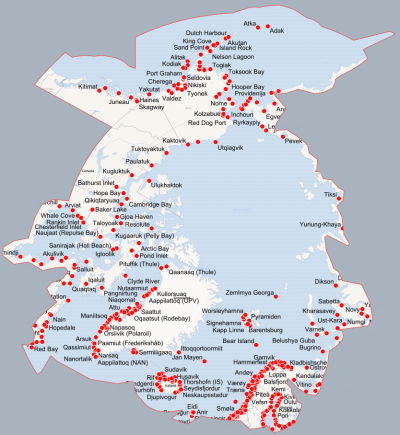
This work has since been incorporated to PAME's Arctic Ship Traffic Data Program (ASTD). The ASTD System now boasts an impressive 450 ports in the Arctic and is working on updating the system to map the facilities in each port to great detail.
Development of a Regional Reception Facilities Plan
PAME currently has a project in its 2025-2027 Work Plan to develop a Regional Reception Facilities Plan (RRFP). It will include ports and terminals of Arctic States which will participate in the proposed RRFP, and ports identified in the RRFP as Regional Ships Waste Reception Centre (RSWRC) as well as all other necessary information to be required by 2012 IMO Guidelines for the Development of a Regional Reception Facilities Plan. Thee Regional Reception Facilities Plan will be submitted to Marine Environment Protection Committee (MEPC) of the IMO.
Main activities of the project:
- RRFP should be developed upon the entry into force of the amendments to MARPOL Annexes I, II, IV, V and VI on regional arrangements for port reception facilities. Relevant amendments regarding regional reception facilities within Arctic waters entered into force on 1 May 2024.
- A correspondence group (CG) should be established for implementation of this project. All Arctic States are invited to submit all necessary information.
- GISIS IMO and Arctic Port Reception Facilities Inventory will also review for obtaining background information for implementation this project.
- The Arctic States should consider and identify the Regional Ships Waste Reception Centres (RSWRC)
- The CG will hold virtual meetings for consideration of the ongoing status project as well as outstanding issues.
- Permanent Participants are invited in the implementation of the project, especially in exchanging, if appropriate, the knowledge regarding the treating, reusing, recycling, destroying or otherwise managing ship generated wastes and cargo residues collected by waste transporters.